
Some stories from Sydney’s past begin with grand buildings, famous governors or big historical dates.
But as our guide Claudia often reminds visitors, some of the most powerful stories begin with ordinary people.
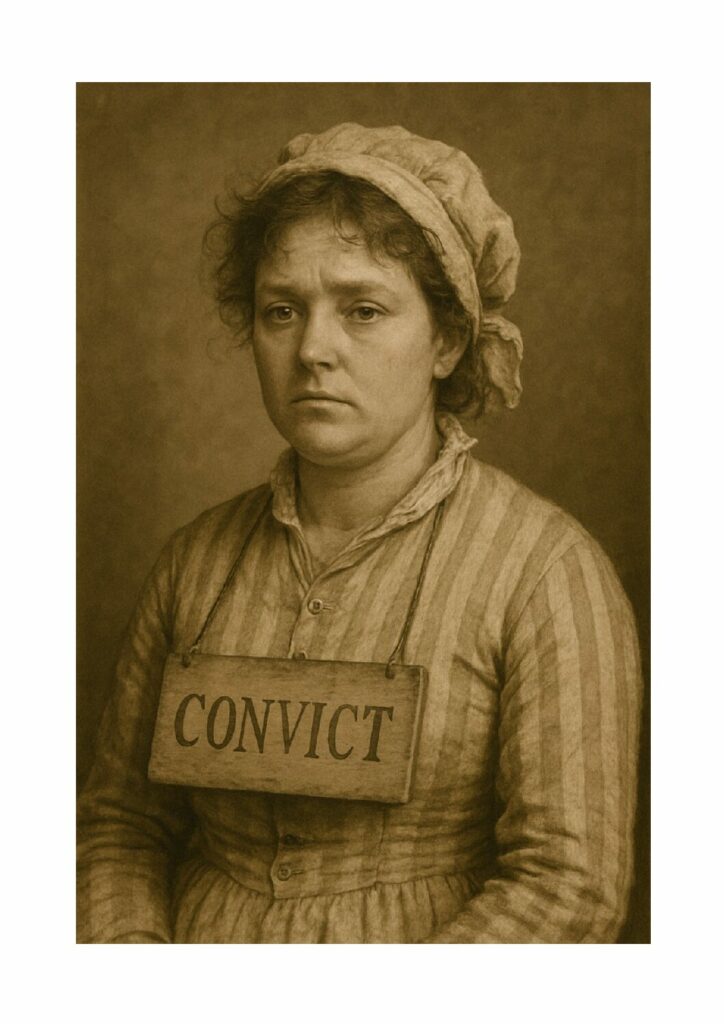
This one begins with a 13-year-old girl standing in a London courtroom.
Her name was Elizabeth Hayward. In January 1787, she was tried at the Old Bailey for stealing a linen gown, a silk bonnet and a cloak. Today, it sounds like a small crime. But in 18th-century England, small crimes could carry life-changing punishments.
Elizabeth was sentenced to seven years transportation.
She would become one of the youngest female convicts on the First Fleet.
A Young Girl Sent Across the World
After her sentence, Elizabeth was sent to Newgate Prison to wait for transportation. She was then placed on board the Lady Penrhyn, one of the ships carrying female convicts to the other side of the world.
The voyage was long, uncomfortable and frightening. Many of the convicts had already spent time in prisons or hulks before the fleet even sailed. They were poor, underfed and vulnerable.
After more than eight months at sea, Elizabeth arrived at Sydney Cove on 26 January 1788.
The place where she landed would become known as The Rocks.
Today, visitors walk through its laneways, past sandstone walls, historic pubs and old cottages. But beneath the charm of The Rocks is a much harder story, a story of poverty, punishment, survival and colonisation.
Why Did the British Come to Australia?
One of the questions people often ask on our tours is: Why did the British come to Australia in the first place?
The simple answer is convicts.
But the real answer is much more interesting.
In the 1700s, Britain was changing rapidly. The Agricultural Revolution and Industrial Revolution were transforming the way people lived and worked. In the countryside, land that had once been used by ordinary people was increasingly fenced off by wealthy landowners. This was known as the Enclosure Movement.
For the wealthy, this meant more control and more profit.
For the poor, it often meant losing the ability to grow food, graze animals or support their families.
Thousands of people moved into towns and cities looking for work. But the cities were overcrowded, jobs were scarce, wages were low, and poverty was everywhere.
For many people, stealing was not about greed. It was about survival.
The Bloody Code
At the same time, Britain had an extremely harsh legal system.
From the late 1600s to the early 1800s, more than 200 crimes could be punished by death. This became known as The Bloody Code.
Many of these crimes were property crimes. People could face terrible punishments for theft, pickpocketing, poaching, or damaging property.
It seems extraordinary now, but in a society where land and wealth were controlled by a small number of people, the law was often used to protect property rather than people.
Even at the time, many people believed the punishments were too severe. Juries sometimes deliberately lowered the value of stolen goods so the accused person would avoid the death penalty.
Instead, many sentences were changed to transportation.
That is how Britain came to send more than 160,000 convicts to Australia between 1788 and 1868.
The First Fleet Arrives in Sydney Cove
The First Fleet left Portsmouth in May 1787. There were 11 ships carrying convicts, marines, officers, sailors and supplies.
Eight and a half months later, they arrived in Sydney Cove. But this was not empty land.
The area now known as The Rocks was part of Tallawoladah, an important place for the Gadigal people of the Eora Nation. Aboriginal people had lived around Sydney Harbour for thousands of years. This place was a fishing ground, a lookout, a meeting place and part of a much older living culture.
The arrival of the First Fleet changed that world forever.
When we walk through The Rocks today, we are not just walking through colonial history. We are walking through layers of history — Aboriginal history, convict history, maritime history, working-class history and the stories of ordinary people who lived through extraordinary change.
Elizabeth Hayward’s Life in the Colony
For Elizabeth Hayward, Sydney Cove was the beginning of a very different life.
She arrived as a teenage convict and was assigned as a servant to Mary Johnson, the wife of Reverend Richard Johnson. In 1789, Elizabeth was sentenced to 30 lashes for “insolence”.
It is only a small detail from the records, but it gives us a glimpse into the strict and often brutal world of the early colony.
And yet, Elizabeth survived. She lived through those difficult early years and died in 1836 as a free woman.
Her story reminds us that many convicts were not hardened criminals. They were poor, young, vulnerable people caught in a harsh legal system at a time when poverty itself was often treated like a crime.
Walking Through the Story Today
This is what makes The Rocks such a powerful place to explore.
You can still walk through narrow laneways, stand beside old sandstone walls and imagine the lives of people like Elizabeth Hayward. The streets may now be filled with cafés, galleries, shops and visitors, but the past is still there if you know where to look.
The Rocks is not just a pretty historic neighbourhood.
It is the place where the British colony began. It is where convicts arrived, worked, struggled and survived. It is also a place where Aboriginal history, colonial ambition and human hardship are deeply connected.
Visit The Rocks and Discover Sydney’s Early History
If you want to understand Sydney’s beginnings, The Rocks is the best place to start.
On our guided walking tour, the stories are not locked away behind glass. They are found in the streets, laneways, sandstone walls, harbour views and hidden corners that many people walk straight past.
Book our daily tour at 10.30am and 1.30pm, seven days a week, and discover the stories behind Sydney’s oldest neighbourhood.